Skip to content

The field of packaging labelling is developing rapidly. In addition to already established requirements, it is also significantly influenced by new European legislation, such as the Packaging and Packaging Waste Regulation (PPWR) and the Deforestation-free Products Regulation (EUDR), which bring additional requirements for companies regarding traceability, sustainability, recyclability, and the provision of information throughout the entire life cycle of the packaging. Therefore, when developing new packaging, it is important to monitor current regulations and the requirements of individual markets.

On the packaging, we find numerous markings that communicate important information to consumers and business partners about the product, materials, recycling options, proper handling of waste packaging, and compliance with applicable legislation. Some markings are legally prescribed for individual types of products or packaging, while others are used by manufacturers voluntarily to emphasize sustainable practices, certified materials, or other product characteristics.

Markings on packaging are crucial for both B2B users and end consumers, as they ensure transparency regarding materials, recycling, environmental certificates, safety requirements, and product compliance. Among the most commonly used markings are markings for materials (PAP, PET, ALU…), the recycling symbol, FSC®, CE (where required), WEEE, markings for cosmetic products, ecological certificates, and numerous other markings whose use depends on the type of product and applicable legislation.

When placing markings on packaging, it is important that they are clearly visible, legible, and compliant with legislative requirements. Correct use of markings not only ensures compliance with regulations but also strengthens customer trust and supports sustainable and responsible business.

On this page, we have collected the most commonly used markings on packaging. To facilitate packaging planning, we have also prepared PDF files of individual markings, which you can download for free and use in the preparation of the graphic design.

Markings on CARDBOARD PACKAGING

Mobius loop symbol

The Mobius loop symbol is a general recycling mark indicating that it is technically suitable for recycling at the end of its life cycle (but not necessarily included in a recovery system). Each arm on the mark represents a part of the chain necessary for successful recycling (e.g., collection, processing into a new product, and purchase of a product made from recyclate).

In Slovenia and EU countries, the mark is not among the mandatory signs on packaging. Nevertheless, many companies use it voluntarily to mark their packaging as part of an environmentally conscious strategy.

In some cases, there is a number inside the triangle indicating the type of material, and a material abbreviation – more in the section below, Markings for cardboard and paper.

Graphics download

Markings for cardboard and paper

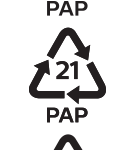
Markings for cardboard and paper are part of the packaging material identification system but are not mandatory markings on packaging. The Directive stipulates that packaging must be marked in a way that facilitates collection, reuse, and recycling, using a numerical identification system. The mark consists of a number in a triangle and an abbreviation below the mark, indicating the type of material.

• PAP 20 – corrugated cardboard
• PAP 21 – non-corrugated cardboard
• PAP 22 – paper
The use of this mark is not mandatory, but it is recommended for easier identification and separation of packaging materials. Packaging marking requirements are specified in more detail in Article 9 of the Decree on the management of packaging and packaging waste. You can find more about these markings on the website.

Graphics download

Green Dot

The Green Dot mark is one of the most commonly used signs on packaging, indicating that the packaging is included in a packaging waste management system. This means that the company using this mark pays an environmental levy and thus contributes to the organized collection, recycling, and recovery of packaging. The use of the mark is subject to membership in a specific packaging system (in Slovenia, this is the company Slopak). You can read more about packaging and packaging waste on the website Directive 94/62/EC on packaging and packaging waste.

File download

Tidyman

The Tidyman symbol warns that packaging must be disposed of in an appropriate place. It is not generally mandatory under European legislation. However, individual EU member states or certain packaging systems may require its use as part of raising awareness about proper waste separation.

Graphics download

WEEE

The WEEE mark indicates that waste electrical and electronic equipment (mobile phones, televisions, batteries, household appliances, etc.) must be collected separately and must not be disposed of with regular household waste. This mark must be obligatory on the packaging of every piece of electrical and electronic equipment placed on the EU market. You can read more about the mark at the following link.

Graphics download

Period After Opening

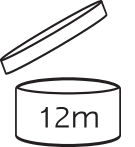
The Period After Opening symbol is a symbol that indicates the time period of safe use of a cosmetic product after opening. It is often seen on the packaging of creams, shampoos, makeup, and other cosmetic products that have a longer shelf life. The symbol shows a small open jar with an inscription, e.g., 6M. The number indicates how many months the product is safe to use after opening.
It is a mandatory mark on the packaging for cosmetic products that have a shelf life longer than 30 months.

Graphics download

Hourglass

The hourglass symbol indicates the date of minimum durability of a cosmetic product, which means that the product is safe and effective until a certain date if stored under appropriate conditions. It appears on cosmetic products where the shelf life does not exceed 30 months. The date of minimum durability is stated next to the symbol (e.g., 31/12/2025). After this date, the product may no longer be as effective or safe to use.
It is a mandatory mark on the packaging for cosmetic products that have a shelf life shorter than 30 months.

Graphics download

Nominal quantity

The “℮” mark (e-mark), which is often seen next to the indication of the weight or volume of a product, means that the packaging contains the nominal quantity of the product in accordance with European metrological regulations. It confirms that the stated quantity of the product is measured in accordance with standardized EU methods. It allows for the free sales flow of products throughout the European Union without additional verification of quantities in individual member states. It is used for products that are packaged without the presence of the buyer and have a pre-determined weight or volume (food and beverages, cosmetic products, chemicals and household products, pharmaceutical products).
The use of the “℮” mark is not mandatory, but manufacturers often use it to prove compliance with legislation and to facilitate easier export of products within the EU.
You can find more about this mark on the website.

Graphics download

European conformity

The CE mark (Conformité Européenne) is a mark indicating that the product meets the safety, health, and environmental requirements set out in European Union legislation. It is a mandatory mark for certain groups of products sold in EU member states. It confirms that the product complies with European standards for safety, health, and the environment, and allows for the free movement of products within the European Union without additional testing in individual countries.
It is a mandatory packaging marking for products that fall under harmonized EU directives, such as: electronic devices (e.g., phones, computers), toys and children’s equipment, medical devices, construction materials, and personal protective equipment (e.g., masks, gloves). For food, cosmetics, and chemicals, the CE mark is not applicable, as these products fall under other legislative frameworks.
You can read more at the following link.

Graphics download

Euro-leaf

The Euro-leaf is the official organic logo of the European Union, used to label organically produced food and feed. The mark confirms that the product complies with EU legislation on organic production and meets strict conditions regarding production, processing, and distribution. It ensures that the product is produced without synthetic pesticides and fertilizers. It means that at least 95% of the ingredients of agricultural origin come from organic production. The entire production chain is monitored – from the farm to the final product. It emphasizes care for sustainable farming and animal welfare.

If a product is labelled as “organic” and is sold in the European Union, the Euro-leaf mark on the packaging is mandatory. In addition to the mark, the following must also be stated: the code of the control body and the origin of the raw materials. If a product contains less than 95% organic ingredients, the Euro-leaf may not be used. It is used on organically produced food, organic baby food and food supplements, organic flour products and bakery products, and packaged organic food in stores.
You can read more information at the following link.

Graphics download

Look for our FSC®‐certified products

The FSC (Forest Stewardship Council®) mark is an international certification system that ensures that wood and paper products originate from responsibly managed forests and sustainable sources. The FSC mark on the packaging means that the materials are obtained in a way that respects environmental, social, and economic standards.

The FSC mark is not legally mandatory, but companies use it voluntarily as proof that their products comply with the principles of sustainable development. If a company wishes to use the FSC mark on packaging, it must have a valid FSC certificate. It is necessary to use the officially approved FSC mark with the correct dimensions and design and to obtain confirmation of the logo’s use from a certified FSC organization before printing the packaging.

For a better understanding, you can look at the following website or in our newsletter. Our FSC® mark is FSC-C106947, the validity of which you can check on this website.

Download instructions

EU Ecolabel

The EU Ecolabel is the official environmental mark of the European Union, which identifies products and services with a reduced environmental impact throughout their entire life cycle – from raw materials to production, use, and recycling. It means that the product or packaging with the mark meets strict environmental and sustainability criteria set by the European Commission. Certified products must have a low level of pollution, reduced resource consumption, and be suitable for recycling. The EU Ecolabel helps consumers identify more sustainable and environmentally friendly products.

It is not a mandatory mark on packaging, but a voluntary certificate that companies can obtain if their packaging meets strict environmental requirements.

You can read more about this on the following websites.

Graphics download

Legislative overview for packaging waste

Legislative overview for paper and board for food contact

Legislative overview for paper and board for food contact

Umbrella EU legislation

  • Regulation (EC) No 1935/2004 of the European Parliament and of the Council of 27 October 2004 on materials and articles intended to come into contact with food and repealing Directives 80/590/EEC and 89/109/EEC
  • Commission Regulation (EC) No. 2023/2006 of 22 December 2006 on good manufacturing practice for materials and articles intended to come into contact with food

EU legislation for material groups

  • Commission Regulation (EU) No 10/2011 of 14 January 2011 on plastic materials and articles intended to come into contact with food
  • Commission Regulation (EC) No 450/2009 of 29 May 2009 on active and intelligent materials and articles intended to come into contact with food
  • Council Directive of 15 October 1984 on the approximation of the laws of the Member States relating to ceramic articles intended to come into contact with food (84/500/EEC)
  • Commission Directive 2007/42/EC of 29 June 2007 relating to materials and articles made of regenerated cellulose film intended to come into contact with food

Specific EU legislation

  • Commission Regulation (EU) No 284/2011 of 22 March 2011 laying down specific conditions and detailed procedures for the import of polyamide and melamine plastic kitchenware originating in or consigned from the People’s Republic of China and Hong Kong Special Administrative Region, China
  • Commission Directive 93/11/EEC of 15 March 1993 on the release of N-nitrosamines and N-nitrosatable substances from elastomers or rubber teats and soothers
  • Commission Regulation (EC) No 1895/2005 of 18 November 2005 on the restriction of use of certain epoxy derivatives in materials and articles intended to come into contact with food
  • Commission Regulation (EC) No 282/2008 of 27 March 2008 on recycled plastic materials and articles intended to come into contact with food and amending Regulation (EC) No 2023/2006

National legislation

PPWR in practice most common customer questions

What proportion of recycled fibres must cardboard packaging contain?

Currently, PPWR does not prescribe a minimum proportion of recycled fibres for paper or cardboard packaging. Many customers require a certain proportion of recycled fibres due to their own ESG goals, but this is currently not a legal obligation. Minimum proportions of recycled content are prescribed in PPWR primarily for plastic packaging.

Do I already have to use the new PPWR markings on packaging today?

No. Harmonized EU waste-separation symbols and material markings will be introduced gradually. Most requirements regarding new markings are expected from 2028, when detailed technical specifications will also be published. Until then, the currently valid national or European requirements apply.

Does packaging already have to be recyclable today?

PPWR will start to apply in August 2026, but many technical requirements are being introduced gradually. Packaging manufacturers are already developing packaging according to “Design for Recycling” principles, as recyclability requirements will become increasingly strict in the coming years.

Does FSC certification mean compliance with PPWR?

No. FSC confirms responsible forest management and the traceability of wood fibres. PPWR, on the other hand, regulates requirements regarding packaging design, recyclability, labelling, and waste reduction. FSC and PPWR complement each other, but one does not replace the other.

Does EUDR also apply to cardboard packaging?

Yes, when the packaging contains materials that fall within the scope of the EUDR regulation (e.g., wood fibres or paper). However, EUDR does not specify graphic markings on the packaging, but rather requires proof of the legal origin of the raw material and the implementation of a due diligence system in the supply chain.

Newsletter Sign-Up

Stay up to date with the latest trends and innovations in the packaging industry.